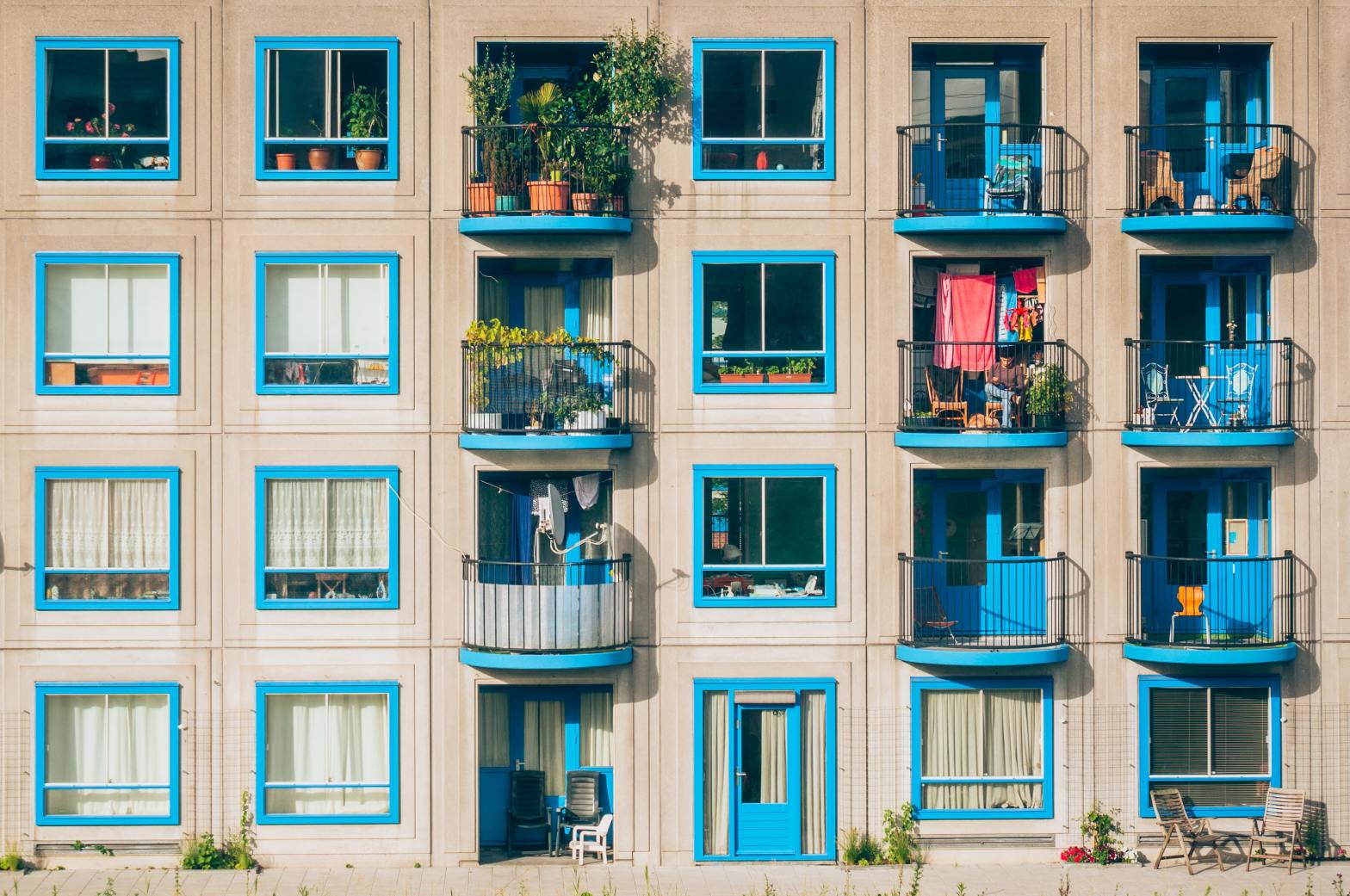
should covid prompt a design rethink in build-to-rent blocks?

Published in Property Week, September 2020

Main photo by Ján Jakub Naništa on Unsplash

One of the build-to-rent (BTR) sector’s biggest selling points are the amenities.

As the market has grown, the likes of cinema rooms, gyms and co-working spaces – as well as a host of weirder and more wonderful options – have become standard features. After all, these shared spaces are one of the main differences between renting in a BTR scheme and from a buy-to-let landlord.

It’s fair to say that social distancing during the coronavirus pandemic has thrown a massive spanner in the works. Most amenities were closed during the early days of lockdown, and although they are reopening now, many have reduced capacity.

Conversely, outdoor spaces – whether a balcony, roof terrace or garden – have been in high demand. Co-working spaces have also proved popular in recent weeks, as more people have become comfortable enough to leave their apartments while still working at home.

So, do developers now need to rethink the design of their blocks and the amenities they provide?

“While investment in [BTR] has grown considerably over the last five years, there are lots of schemes still in planning and development,” says Rosie Ashton, an architect in CBRE’s multifamily consultancy.

“Our response to Covid and its impact on how we live now will influence the developments completing over the next few years.”

Encouragingly, those on the ground report that residents are still using amenity space – just in a more careful way. “The spaces are more bookable, it’s more organised and the density is lower,” says Russell Pedley, co-founder of architects Assael, who has worked on BTR schemes including Legal & General’s Blackhorse Mills in Walthamstow. There, even the swimming pool has reopened thanks to a new booking system.

‘Virtual community’

Vertus, Canary Wharf Group’s BTR arm, opened its first building at 10 George Street in mid-February just weeks before the lockdown. Alastair Mullens, head of Vertus, says it created a “virtual community” for residents during lockdown and has now made amenities bookable, moved around furniture to support social distancing and reduced the size of events such as fitness classes.

“It is really important for our residents to be able to continue using these areas in a safe manner,” Mullens says, describing them as “the heartbeat of life at 10 George Street”.
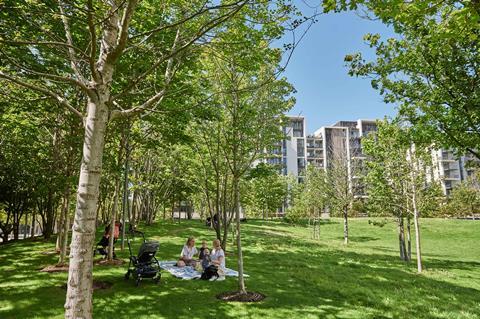
East Village Summer
East Village: Get Living says residents value amenities that are ‘an extension out of their apartments’

Different amenities pose different challenges, however. Christian Armstrong, director of brand, product and technology at Get Living, says residents are really valuing amenities that are “an extension out of their apartments”, such as the sky garden at its Elephant Central scheme. This is supported by anecdotal reports that some operators are looking to up their amenity provision due to demand from residents. However, Armstrong says “highly communal spaces” like cinemas are “more difficult to provide” at the moment.

Flexible spaces

Wisely, those drawing up new BTR developments are designing in flexible spaces that can be adapted to more than one use. Before coronavirus, some developers had started to build ‘shell’ amenity spaces that they could adapt over time based on residents’ needs – but in the Covid era spaces could change use in the space of a single day.

John Badman, director at global architecture, planning and design practice CallisonRTKL, envisions “adaptive spaces that can change by the hour – yoga in the morning, co-working space at lunch and a pop-up bar in the evening”.

Assael has been asked to carry out ‘audits’ on amenity space in BTR developments since the pandemic took hold, and has added features such as wider corridors and separate up and down staircases to enable social distancing.

“It’s important to think about design resilience,” says Pedley. “Right now, the issue might be social distancing because of Covid, but in future the space could be holding a large-capacity event and those features would still be beneficial.”

Covid’s impact will influence developments in the next few years

Rosie Ashton, CBRE

Others see less need to hedge their bets. “Will BTR residents still use cinemas and gyms? Sure they will,” says Graham Bates, senior director strategy – Europe at LIV Group. “This will pass. Design should be about what is right for the building and the target demographic.”

One amenity everyone agrees BTR needs to factor in, whether in apartments or in the communal space is a functional place to work.

“If you’re working from home, things like fast internet, co-working spaces, a gym and on-site food and beverage are a benefit,” says John Dunkerley, chief executive of BTR investor Apache Capital Partners.

He adds that Covid has “probably accelerated” the letting of its Angel Gardens scheme in Manchester, which is now more than 50% occupied.

Demand for workspace could see a shift in priorities in terms of BTR amenities, believe some.

“Where once you might have found a cinema room, in future it will be a printing room complete with stationery cupboard, while the bookable dining room will double as a virtual boardroom,” says Badman.

“The concierge will offer IT support, while phone booths might pop up along corridors to allow meetings and video calls to be taken privately.”

Schemes at the design stage certainly look to be including more co-working space. “We are advising clients to design spaces for co-working and in some cases, spaces previously allocated for commercial use are now being repurposed,” says Bates.

Repurposing space

Operators are also rushing to repurpose space in existing buildings. Get Living, for example, is converting its front offices into workspace.

“We’re starting to see the fabric of the community come together,” says Armstrong.

“You can’t artificially create a community, but people working from home more is contributing to that.”

Not everyone wants to work collectively, though, particularly in this time of social distancing – and this could prompt a rethink of how space is allocated inside individual flats.

Because of the economic imperative for critical mass in BTR schemes, it is unlikely we will ever see studies being provided en masse.

“It’s probably going to be more down to intelligent design rather than increasing floor areas,” says Mark Clegg, international partner at Cushman & Wakefield.
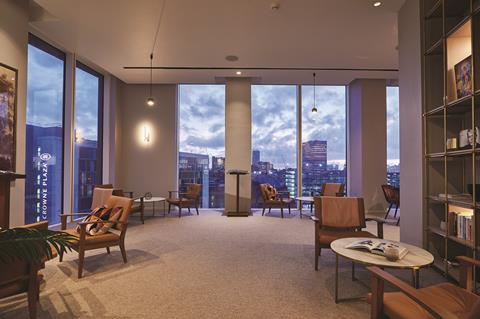
Angel Gardens
Angel Gardens: Apache Capital Partners says Covid-19 ‘probably accelerated’ the letting of its Manchester scheme

Pedley adds that “something like a cupboard opening or a space in front of a bay window” could become a functional desk space, while Lesley Roberts, executive development director at Allsop, says the whole layout of apartments could be radically changed to create a true hybrid space.

“I think we might see more ‘work-live’ units like we saw in east London in the 1980s and 90s,” she says. “It’s the sort of thing that BTR could embrace.”

Residents are also becoming more discerning about the specifications of their apartments, having spent so much time in them.

“They’ve been paying more attention to things like the quality of light, aspect, fresh air, biophilic design and layout,” Roberts says.

One element that comes up time and time again is the need for outdoor space. During lockdown, the divide between those with proper balconies and those without was thrown into sharp relief, and as such, private outdoor space has become a priority for those developing or investing in BTR.

“Conversations I’ve had with developers and investors over the past couple of months suggest the days of the Juliet balcony are over,” says Clegg.

Where balconies are not economically feasible, for example in lower-priced units, communal outdoor areas will be vital.

“We already see developers introducing sheltered outdoor spaces such as podium and rooftop gardens, as well as traditional ground-floor-level communal gardens, which can be zoned to support social distancing,” says Ashton.

Ultimately, though, there’s only so much green space an inner-city apartment block can provide. With so many of us reconnecting with nature during the pandemic, could the golden rule that BTR schemes must be within striking distance of a station start to shift?

“Renters might be happy to walk an extra five or 10 minutes to the station if their apartment is next to a park,” says Clegg, while others go even further, suggesting Covid might be the catalyst for BTR to finally make its move out of the city.

Suburban BTR

“We’ve noticed there’s more appetite to live in suburban build-to-rent,” says Pedley, who envisions the rise of the “garden-style development, where amenities are housed in a centralised clubhouse, and there are individual houses and small apartment blocks in a parkland setting”.

Really, the debate about the future of BTR relies on making guesses about how quickly life might return to some kind of normality – and what that ‘new normal’ might look like.

Knee-jerk responses don’t seem like a good idea to me

Graham Bates, LIV Group

While there are plenty of ideas and lots of short-term tweaking of amenity space, no one is rushing to make sweeping long-term changes.

“Knee-jerk responses don’t seem like a good idea to me, when over the longer term Covid-19 will hopefully not be present,” says Bates.

Covid has been a reminder of the unpredictable factors the industry deals with when designing buildings, and how quickly things can change in the few years it takes for a floor plan to become a functioning building. These are things that are very difficult to plan for.

“If we change everything to make it fit-for-purpose to avoid contagion, then what’s the next thing to come along?” says Roberts. “It reminds me of when the iPod came out and all the new cars were fitted with iPod jacks, and then three years later they were obsolete.”

The only way the sector can prepare for the future is to make sure buildings are adaptable and resilient. Those that don’t rise to the challenge could find that in the new normal, their buildings are a whole lot less popular than they were in the old.

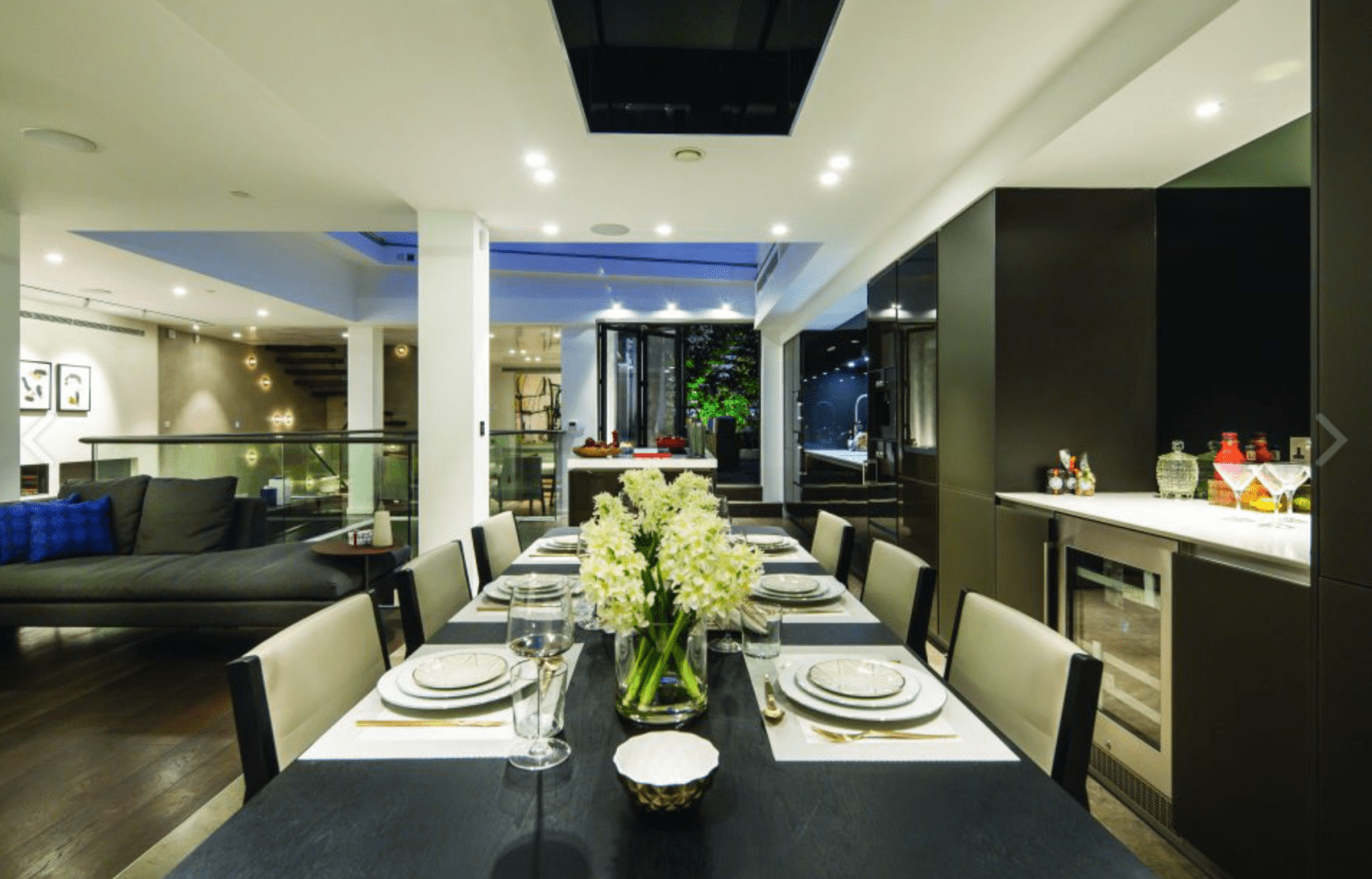
London festival of architecture panel: rethinking city homes for a post-pandemic world

I chaired a panel with Ben Adams of Ben Adams Architects and Michael Katsibas of KAP Studio as part of the digital London Festival of Architecture.

We discussed how design can improve residents’ health and wellbeing in apartment blocks using two example projects in London and Los Angeles, as well as the importance of social spaces and how community can be encouraged in the post-Coronavirus era.

How a Notting Hill garage was transformed into an LA-style luxury home

Published in City A.M., Nov ’19

When you think of Los Angeles, you probably imagine broad, sun-drenched streets, palm trees and the kind of airy, modern villas that we see on TV and in the movies.

It doesn’t have much in common with rainy London – but that didn’t deter the designers of a new home in Notting Hill, who set out to replicate the LA vibe on the site of a former car garage.

Project manager LXA and architect Gebler Tooth utilised space between existing buildings to create The California – a spacious five bedroom, five bathroom home off Hereford Road, which also has two large reception rooms, a patio and a roof terrace. The property’s size is masked by its discreet street entrance, a feature which the designers have likened to Marrakech’s famous riads.

“It is a Narnia site – it has a tiny little entrance gate at the front, and then you walk through a narrow corridor and the whole building opens out in front of you,” says David Rees, managing director at LXA. “It feels secure because you’re 50 yards away from the street, and there are three levels of security before you get in – which makes it a great family home.”

Inside, a 20ft atrium links the three storeys, bringing light into the home which was largely built underground due to planning constraints. The roof can be opened in the event of LA-style weather, and is thought to be the largest retractable glass ceiling in a London home.

“You feel as if you are outside all the time,” Rees says. “A lot of other properties in the Notting Hill area are classic Victorian semis, but this is a completely unique proposition. It is a contemporary, modernist building.”

The interiors are elegant and minimalistic, with dark wood flooring, white linen soft furnishings, olive accents and modern art pieces on the walls. The home has also been fitted with under-floor heating and computerised smart lighting.

LXA and Gebler Tooth developed the home speculatively, but it has now been bought by a London family who were attracted by its unique features. “They felt there was nothing else like this around,” says Rees. “They didn’t want to change anything, and they even kept the art that we put on the walls.”

FIRST LOOK: ZAHA HADID ARCHITECTS’ FLOWER-INSPIRED LOBBY FOR SOUTHBANK TOWER

Published in City A.M., Nov ’19

The critically-acclaimed firm of architects founded by the late Zaha Hadid is responsible for London cultural landmarks like the London Aquatics Centre built for the 2012 Olympic Games and the Serpentine Sackler Gallery in Hyde Park.

Until now it had not worked on any residential projects in the UK, but it has just started a new commission to redesign the lobby of Southbank Tower – the 1972 Richard Seifert-designed office building which was converted into 191 apartments in 2015.

City A.M got an exclusive first look at its plans for the project, the centrepiece of which is a bold feature lighting scheme inspired by the intricate, organic forms of flower petals.

The sculptural petals, made from glass fibre reinforced gypsum, reflect the fluid shapes seen in lots of Hadid’s work, which led to her being dubbed ‘the Queen of the curve’. Her other major works included Guangzhou Opera House in China and Sheikh Zayed Bridge in Abu Dhabi.

“The design has evolved from our work reinventing the spaces of art museums and galleries around the world,” says Helmut Kinzler, project director at Zaha Hadid Architects (ZHA). “We took a sculptural approach to the space, and decided not to include any works of art because we see it as a canvas in itself. We also wanted to incorporate lots of light, because sculpture can only work in conjunction with light.

The petal forms will be made in an off-site studio using 3D digital files, which ZHA says will allow it to create a level of detail usually associated with “intricate, hand-crafted design works.” The fluid curves of the structure will house the concierge on the ground floor, before peeling back at the top to reveal a new mezzanine level.“Residents will have a place to meet whoever comes in, and they can have small parties and gatherings there,” says Kinzler.

The lobby’s material and colour palette draws inspiration from the existing building design, marrying marble and concrete with walnut, leather and silks.

The work has been commissioned by a private investment firm which acquired 37 apartments in the 41-storey tower in early 2018. It will re-launch the apartments to the market following the completion of the lobby, and has appointed Knight Frank and JLL as sales agents.

Office Space: Inside the opulent Mayfair base of luxury property developer Clivedale

Published in City A.M., November 2019

Real estate firms’ offices tend to fit into one of two moulds: a converted Mayfair townhouse, an old-fashioned relic left over from the days where Hanover Square was overrun with estate agents in braces and pinstripe suits; or a clinical, corporate space interchangeable with that of any other property company, law firm or accountant.

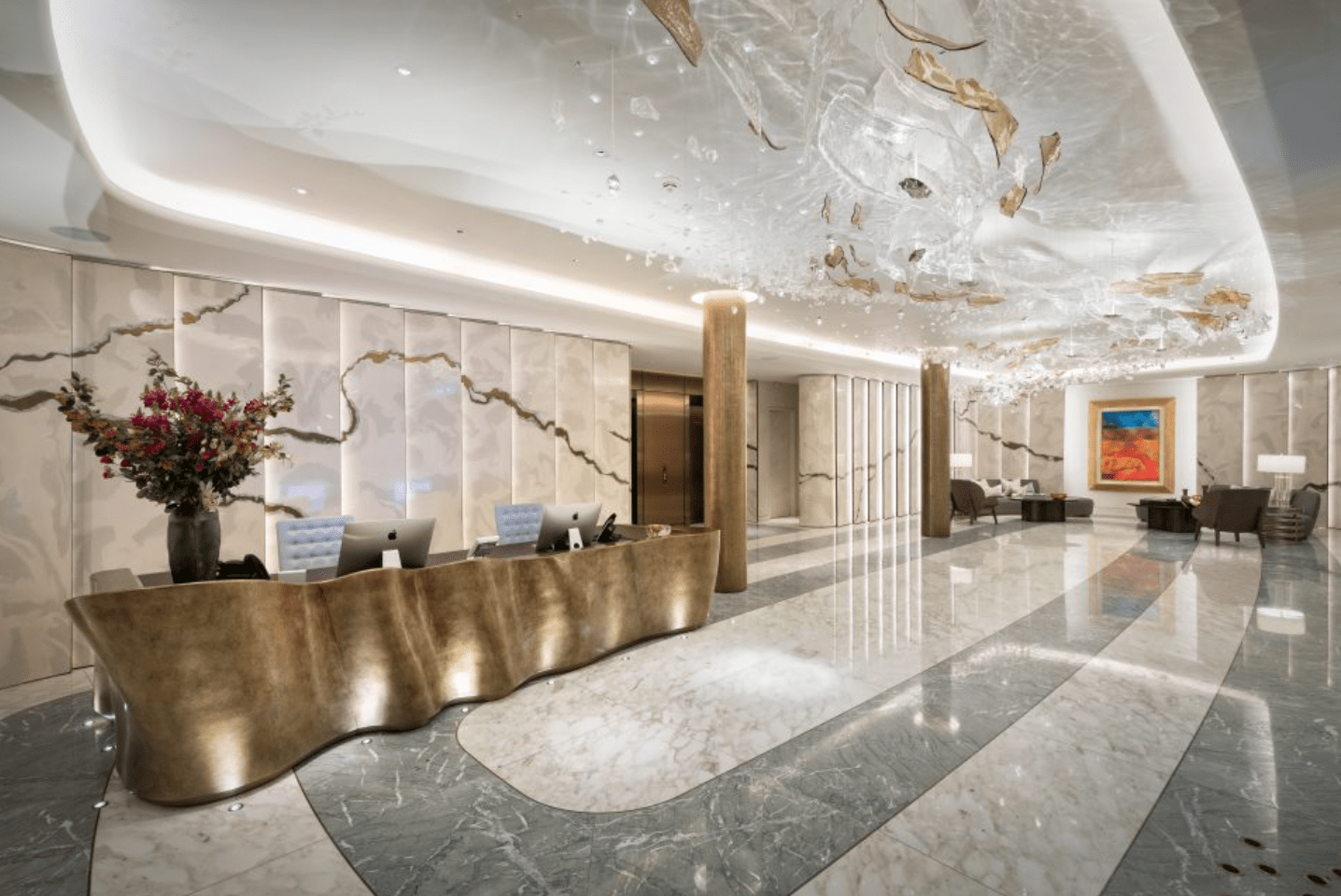
Super-prime property developer Clivedale’s is neither, and it shows the moment you walk through the door. The entrance lobby at 73 Brook Street in Mayfair sits beneath a glistening sculpture, a kind of deconstructed chandelier where curved pieces of transparent and amber glass are suspended across the entire ceiling.

Opulent, striking and modern, it immediately tells you what Clivedale is about – and it should, because the company developed the office building itself.

The sculpture was created by design studio Haberdashery, and is supposed to look like water, alluding to Brook Street’s previous life as – no prizes for this one – a river. Creating a “dramatic sense of arrival” was a priority for the building according to development director David Laycock. “The material is almost liquid-like, and it scatters light across the ceiling and floor like a moving river,” he says.

The company, which is less than a decade old, has already made a name for itself developing some of the most luxurious apartments in central London. 
“We are an exclusively super-prime developer with an eye for detail and an innate understanding of the global ultra-high-net-worth investor,” says Fred Scarlett, Clivedale’s sales and marketing director.

He wanted the office to reflect how the company is “setting new precedents in craftsmanship and service.” Studio Indigo was the interior designer, but Clivedale was involved throughout. It shares the building with just one other small company, which only occupies it part time, so it had plenty of opportunity to put its stamp on the place.

An office for grown-ups

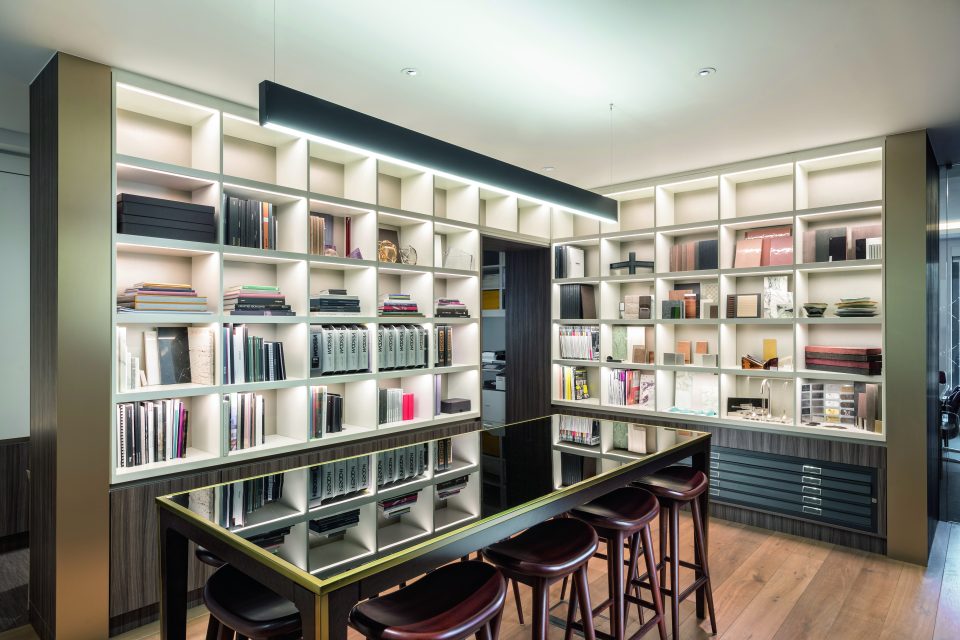
Clivedale is developing high-end apartments at the Residences at Mandarin Oriental Mayfair, and when I visit its office, there’s a table covered with weighty silver taps, slabs of glass and marble, super-soft carpet samples and fabric swatches it plans on using there.

This meticulous approach has clearly been replicated in the design of its own office. In a world of photo-fit WeWorks, it’s refreshing to see an office that isn’t even trying to be techy and trendy. If your standard co-working space looks like a child’s playroom, this is the grown-ups’ dining room where the best china is kept.

When Clivedale’s clients, who include some of the wealthiest families from both the UK and abroad, come to Brook Street, Laycock wants them to see “a world-class office building that reflects the quality we are delivering across our portfolio”.

The Mandarin Oriental apartments are going up on the site of one of Clivedale’s former offices in Hanover Square, which it vacated to move to Brook Street in late 2017. It also had a smaller back office on Bruton Street.

The Hanover Square space was more of a marketing suite than a workplace, and the larger floorplates at 73 Brook Street allowed it to separate these two functions on to different floors.

Moving out of the ‘goldfish bowl’

Another gripe with the old base was that, thanks to its location just behind Oxford Street, its “goldfish bowl” full-length windows and the fact that it was filled with pretty-looking models of houses, passing tourists would often let themselves in for a look around. Not ideal when you’re sitting down with a sensitive high-net-worth client.

Its new marketing suite, which takes up a whole floor of 73 Brook Street, is an intimate space designed for potential buyers to chat with the team one-on-one: think dark wood panelling, veined marble floors and plush soft furnishings in shades of slate and dusty blue. It also doubles up as an entertaining space, and Clivedale has held many a cocktail reception there. Laycock says he wanted the space to “mimic the look and feel of a five-star hotel,” and it doesn’t disappoint.

The centrepiece is a metal model of London with the location all of Clivedale’s developments marked out. Its stone and chrome plinth doubles up as a dinner table when the model is removed. It’s just one example of how it’s created a space which is, as Laycock describes it, “rich in design but completely functional.”

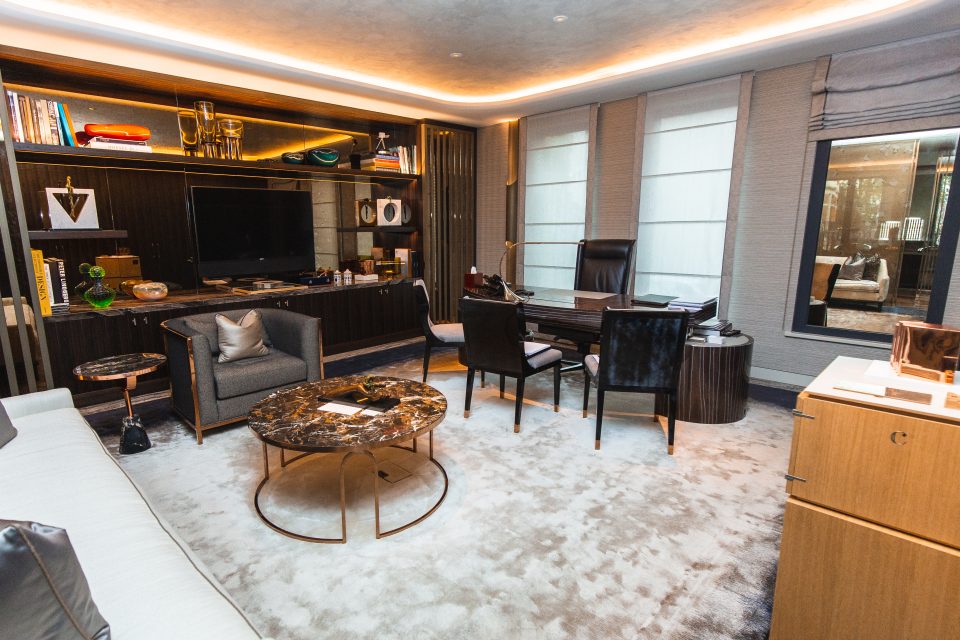
Laycock’s office is on the showroom floor, and, with its sumptuous grey carpet, marble coffee table and wood-panelled shelves lined with all manner of expensive-looking curios, it looks like a cross between an office from Mad Men and a swanky Mayfair members’ club.

Five-star ethos

Accessed via an equally extravagant lift, which has a ripple-effect wall feature achieved by layering iridescent fabric behind glass, the fourth floor is where the behind-the-scenes work happens, or as Clivedale staff refer to it, where the “messy men” sit (there are women, too, though presumably they’re more tidy). Each bank of desks has a planter filled with succulents at the end, and a gardener comes by to water them every so often.

There’s also a sample-laden table, and desks littered with pieces of fabric and materials. A well-stocked bookshelf contains the usual hard-backed property brochures as well as books about cricket, Victorian Bloomsbury and the history of Vauxhall Gardens.

The five-star ethos of 73 Brook Street continues down in the basement, where employees can enjoy the perfect post-gym set-up: spacious, stone-tiled shower rooms with huge back-lit mirrors, shelves filled with piles of fresh, fluffy towels and an espresso machine for the first coffee of the day. And there’s no stashing grotty gym gear under desks, either: tucked away next to the showers is the staff washing machine, stocked with all manner of detergents.

Clivedale is now in the process of developing another, adjoining office next door, which will make the building 73-77 Brook Street and where it will invite other companies to come and bask in its luxurious glow.

It’s bringing its facilities up to the next level of luxury, too, with plans including a humidor, gun storage and a dumb waiter, with stops on each floor. And it might not stop there. Scarlett says he wants to make “Clivedale quality products” on a larger scale, delivering “the highest standards of architectural and interior design” to more potential clients. He thinks this is crucial if companies want to keep their staff around.

It just goes to show you don’t always need a slide or a beer tap to keep the people who work for you happy. Sometimes, a really nice office with a washing machine will do.

Is your house killing you? Why some people think paint, carpets and furniture could be poisonous

Published in City A.M., October 2019

Think back to the last time you redecorated a room. Did you paint a wall? Lay a new carpet? Buy a shelving unit with a Swedish-sounding name? According to some housebuilders, architects and designers, all of these things could be making you ill.

They say that many common types of paint, carpets, flooring, kitchen and bathroom surfaces, and MDF furniture – essentially everything in our homes – contain chemicals that can be damaging to health. As a result there is a small but growing drive to detoxify new homes, and clean up existing ones. But are our homes really bad for us – or is this just hypochondria’s latest frontier?

The substances in question are called volatile organic compounds (VOCs), and are also found in cigarettes, solvents and cleaning products. The one you’ve probably heard of is formaldehyde, and others include benzene and bisphenol A. While they’re not going to poison you on contact, some believe that long periods of exposure can cause respiratory problems and skin diseases, as well as other, potentially more serious illnesses.

Top 50 architect Perkins and Will has created an open-source website called Transparency which contains a ‘precautionary list’ of materials that contain ‘questionable’ substances, in the hope that architects will start to question the materials they use. The number of substances on the list is currently 56, and the architect’s clients will be informed if any of them are to be used in their projects.

Joseph Homes' No1 Millbrook Park
Joseph Homes’ No1 Millbrook Park, where the developer has tried to reduce chemicals in the building process

“Our hope is that this will influence manufacturers to reformulate products for reduced toxicity” reads the website. “By changing one product, together with our partners in the design and construction process, we believe that we are participating in an effort to change the world.”

The website cites a US government study claiming substances in homes can “interfere with hormone regulation and physical development… lead to neurological problems, a weakened immune system, and more.”

But if the danger is real, why aren’t more people talking about it? Well, it’s almost impossible to prove – and for this reason, little evidence is being collected to even try to prove it.

Lack of evidence

“Isolating the cause of illnesses is very difficult. Is it from their home or pollution out on the streets?” says Peter Newton, architectural director at Barton Willmore and associate lecturer at Oxford Brookes University, who has been researching the hidden chemicals in our homes for more than a decade.

The figures out there tend to be from healthy air campaign groups, and it’s not always clear how they reached them. My Health, My Home says 15.3 million UK homes are at risk of ‘toxic home syndrome’ – when a combination of pollutants, allergens and chemicals mean respiratory and skin diseases “can occur more frequently.” Another such group, Clean Air Day, estimates that 45 per cent of homes exceed “healthy” levels of VOCs.

You know that fresh paint smell? It’s really not good for you

Most housebuilders aren’t paying much attention, but that hasn’t stopped Joseph Homes, which is currently building about 200 homes around London. Its managing director, Michael Bryn-Jones, says the company plans to be “VOC-free” within five years.

“You know that fresh paint smell? It’s actually really not good for you,” he says. “We are looking at the materials we put into homes and the chemical components of them, and asking, are these things we would ordinarily want to be around?”

He says people who buy Joseph homes don’t usually ask about it of their own accord, but they like the VOC-free approach when it’s explained to them. Having fewer scary-sounding chemicals in your family home isn’t a difficult sell – but is there really a serious danger to people’s health? Bryn-Jones says it’s at least “a debate we should be having”.

There is a new market for chemical-free versions of building materials, such as this sound insulation by EO Acoustic which is made out of conifer needles.

Another early mover is Facit Homes, which fits all its homes with a filter where “stale” air is extracted to remove, among other things, “chemicals released from furniture and carpets” and replaces soft furnishings with cement, wood, ceramic tiles and synthetic blinds.

“As concerns grow over air quality and pollution outside the home, particularly in cities, customers are increasingly keen to ensure the air they breathe inside their home is clean and safe,” says director Rhys Denbigh.

The idea of stripping your home of unwanted chemical nasties seems like it should tie in neatly with the current vogue for ‘wellness’ and being eco-conscious. But in reality, the two don’t sit well together. The way to make a home ‘green’ is to make it extremely airtight, so there is as little leakage of energy as possible. But doing that also traps in pollutants, allergens and chemicals.

If you’ve got an eco-friendly home, chemicals are likely to stay in there far longer

“If you’ve got VOCs in [an eco-friendly] home, they are likely to stay in there for longer,” says Newton. “So you have to think about what you put in your house far more.” He adds that in Germany, where lots of homes are built under the strictly-defined green standard, Passivhaus, “you don’t really find people building furniture out of MDF.”

Cleaner by design

Cleaning up the air inside our homes has also caught the imagination of the design industry. For example, at this year’s Global Grad Show in Dubai, which showcases the work of emerging designers across the world, Paulina Kwiatkowska of the Academy of Fine Arts in Warsaw will present a series of sculptures that are displayed as pieces of art, but also cleanse and regulate the air and humidity in a room.

“People are only now realising that the air inside our homes is dirtier and more toxic than out on the streets,” says its curator Eleanor Watson of The Design Museum in London. “And designers are trying to come up with a solution for that that is also aesthetically pleasing.”

One of the air-cleansing sculptures

At the Grand Designs showcase in Birmingham earlier this month, designers AIVAN presented Chip[s] Board: a natural MDF alternative made from potato peel, bamboo, wood and hops which doesn’t contain formaldehyde and is also biodegradable. Atticus Durnell presented That’s Caffeine; a glittering plastic substitute made out of recycled coffee which can be used on kitchen and bathroom surfaces to avoid using petrol-based resin, which also contains VOCs; and EO Acoustic presented sound insulation made out of conifer needles. There more widely available offerings, too – last year Dyson launched a “purifying fan heater” that claims to “remove gases including NO2 formaldehyde and benzene,” yours for £549.

Cost is another barrier to cutting unwanted chemicals from the places we live. With VOC-free alternatives to paint and MDF often being more costly, ‘healthier’ homes might only be for those who can afford it. Ben Adams, founder of Ben Adams Architects, says that while his clients are increasingly interested in achieving “the kind of air cleanliness we see in hospitals,” it is “usually a case of striking a balance between clean air and a sensible budget.” But he adds that people can start by trying to avoid using plastics when decorating their homes, instead using timber, steel, aluminium or leather.

Even if these theories are right, people are going to need a lot more convincing before they believe they can get ill from the stuff that they’ve been putting in their houses for years.

“At the moment, you have to do the work as the consumer,” says Newton. “If you’re deciding between one type of flooring and another, cost is the biggest determinant – and it will remain that way until there is [more evidence] about the risks.”

For now, it’s unlikely many people will be giving that lick of paint a second thought.

‘RETRO-FUTURIST’ INTERIORS BRING BRUTALIST BALFRON TOWER UP TO DATE

Published in City A.M., October 2019

Since it opened in 1967, the 26-storey Balfron Tower in Poplar has gone full-circle.

The concrete behemoth was initially considered the masterpiece of modernist architect Erno Goldfinger, who even took a flat there himself. By the 1980s, it had become a symbol of urban deprivation, featuring in films such as the post-apocalyptic thriller 28 Days Later. But today, the grade II* listed property is once again revered by architecture lovers as a classic example of the Brutalist style.

The Ab Rogers show apartment

It is these urban, well-to-do design aficionados that Poplar Harca and Londonewcastle, who have just carried out a high-end refurbishment and modernisation of the once council-owned tower, will be trying to attract as buyers for the 146 flats.

The developers have just launched two show apartments within the Balfron, created by Ab Rogers Design and 2LG Studio respectively. Both saw an opportunity to play on the building’s harsh, concrete exterior and reference its mid-century heritage, while also adding contemporary twists.

The Ab Rogers show apartment

Working in partnership with Blue Farrier, the former creative director at fashion label Issa, Ab Rogers designed its flat for a fictional occupant named Ursula Kim. According to founder Ab Rogers, Ursula “loves film and vinyls, and collects old objects.” He says she is also meticulous about her home and a fan of vintage design – hence the use of raw materials to evoke “Brutalism in its true meaning.”

The firm retained the red bathroom ceiling from Goldfinger’s original design, and used period furniture in shades of green, yellow and blue. “We felt we were in dialogue with the ghost of Goldfinger,” Rogers says. “It was an extraordinary honour.” It also recycled materials from the construction site to create an aluminium side table and planter base, a glass table and felt headboard.

The 2LG show apartment

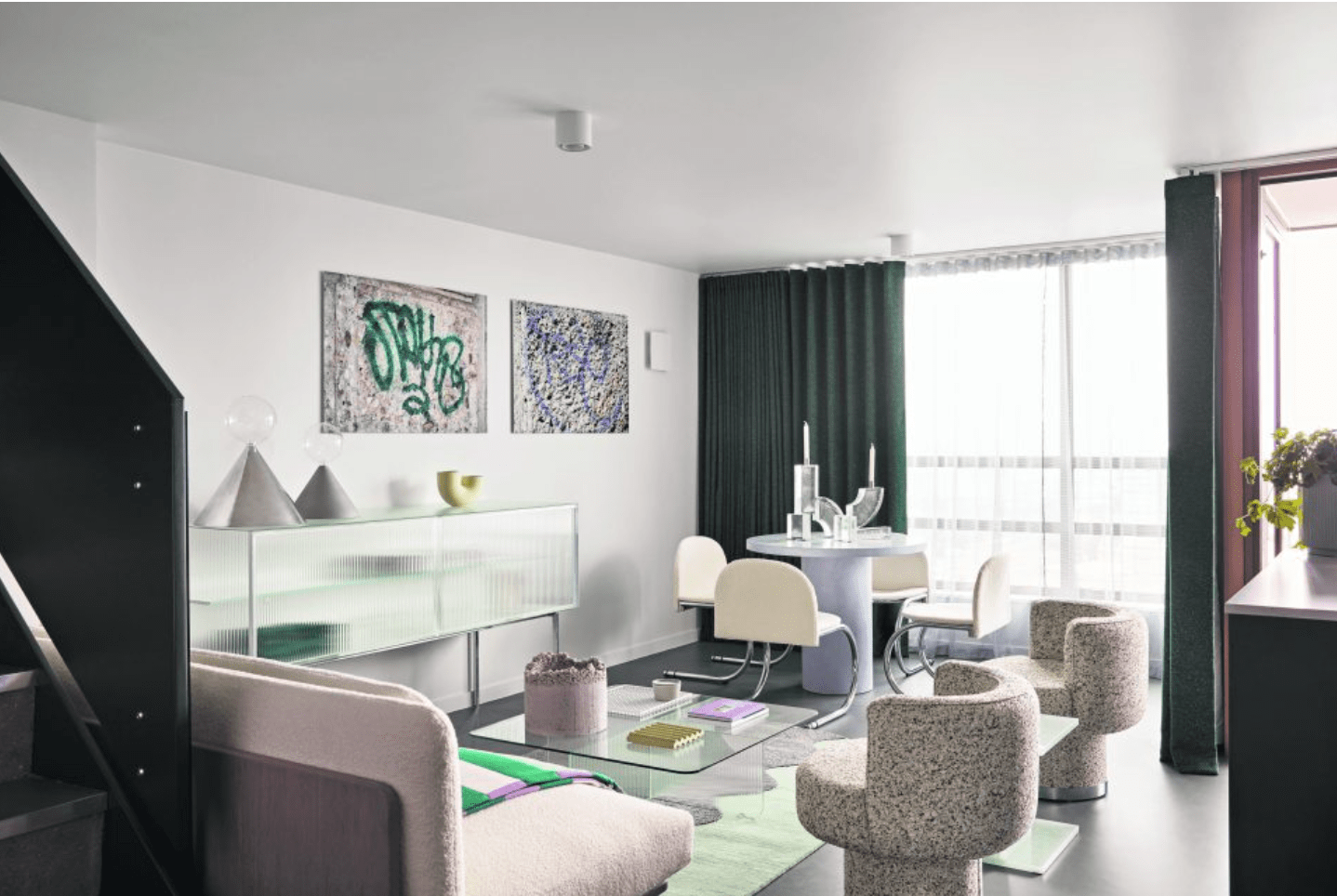
The 2LG apartment also borrows heavily from the Brutalist exterior of the Balfron, incorporating concrete, aluminium and jesmonite but softening this with lilac and mint accents. They created chairs in a speckled, stone-coloured fabric that looks like concrete, as well as a series of photographs, a wallpaper and soft furnishings inspired by the Balfron exterior, which are available to buy.

“Obviously the Brutalism of the building itself was a huge inspiration,” says Russell Whitehead of 2LG Studio. “We wanted to do a retro-futurist take on the Balfron.”

The 2LG show apartment

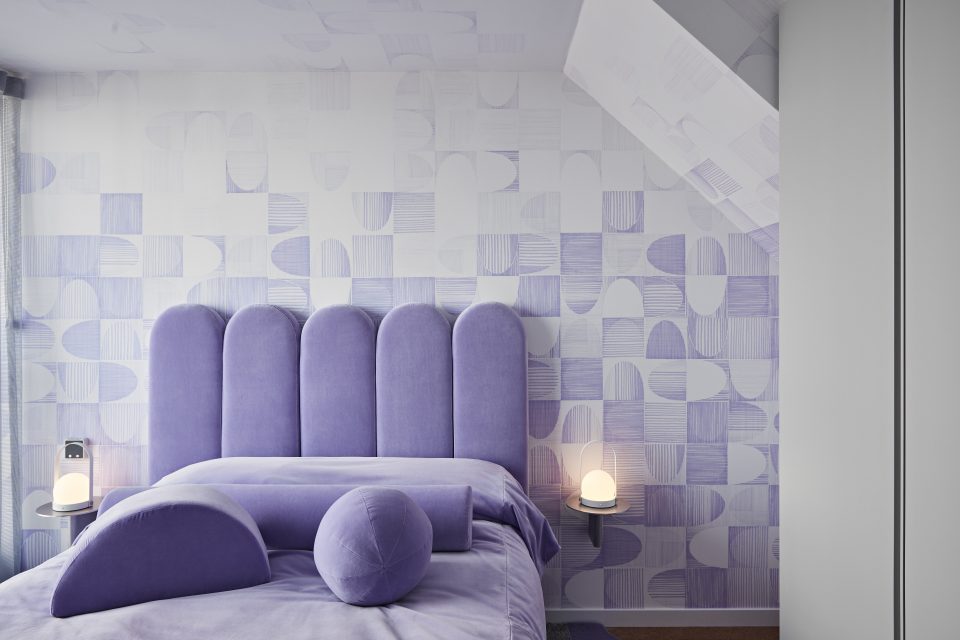
Most of the pieces are bespoke, but the bed with its cushioned lilac headboard – one of the highlights of the show flat – is a tweaked version of one that they produced as part of their collaboration with online luxury furniture retailer Love Your Home.

By fusing grit and glamour, both designers have created quirky, modern apartments worthy of any Ursula Kim.

New homes, shops and cultural venues are set to revitalise a hidden part of Brentford’s industrial past

Published in City A.M, September 2019

Although it is only divided from Kew by a thin stretch of river, Brentford and its West London neighbour could not be more different. Take their history, for example. While the former started out as a country retreat for royals, Brentford has built itself on being a hive of industry.

In the Victorian era a dock designed by Isambard Kingdom Brunel was built there, where workers loaded up boats with coal, steel and timber from the railway to be sent along the river to the Docklands. Post-war, Brentford became the starting point of The Golden Mile – a stretch of art deco factories that once produced everything from gyroscopes to potato crisps.

An event at The Brentford Project. Credit: Daniel Lynch

Developer Ballymore is now trying to capitalise on this industrial heritage by creating a new district combining housing, independent shops and restaurants and cultural spaces. It is called The Brentford Project, and the first homes are available to buy this week.

There is a template for this kind of thing in Peckham and Hackney. But what does post-industrial regeneration look like when it happens just down the A4 from Heathrow? 

Walking down Brentford High Street, the development is impossible to miss. This is because the floor and walls have been painted bright blue, in an installation by artist Huw Morgan. Ballymore’s sales director Jenny Steen tells me this is to signpost the presence of the water, which “even some residents have forgotten about” because it was closed off for many years.

A show home interior

Ballymore has already opened a hipster-friendly cafe and events space on the waterside to try and pull people into the 11.8-acre site. Over the summer it has played host to live music, art and baby yoga. It is building a total of 876 new homes, the first phase of which will comprise 300 studio, one, two and three-bed apartments starting from £369,500. Steen says The Brentford Project is aimed at “people who love to be in their home,” and the spacious show flat boasts unusually high ceilings, a range cooker and a balcony that could comfortably fit a dining table and four chairs.

In keeping with the local area, lots of the apartments will have an industrial feel: think cantilevered balconies and concrete worktops.

There is already a cafe on site

Ballymore also has plans for 50 new retail spaces, including a new set of pedestrianised ‘lanes and yards’ which will play host to independent retailers, craftspeople and artisans. A 15th-century church will become a ‘cultural and foodie hub’ with an open-air pool in the grounds.

John Mulryan, group managing director at Ballymore, says he wants the project to “bring fresh energy to the area in a way that honours and builds on its historic past – as well as its abundance of creativity and culture.”

Duke of London. Credit: Daniel Lynch

Already installed on the site is classic car restoration business, Duke of London. As well as a working garage and forecourt, it also runs an events space, The Factory, which is as likely to be found hosting a supper club as it is a meet for motor enthusiasts. It will soon be offering food from Le Swine and Santa Maria Pizza, and is even set to host an event for London Fashion Week.

“I’ve lived in this area all my life, and before this there wasn’t much reason for people to venture past the Chiswick roundabout,” says founder Merlin McCormack.

There is still a long way to go – but it looks as if that is starting to change.

The modular model: Can factory-built homes solve the housing crisis?

Published in City A.M., September 2019

Picture a vast warehouse somewhere in the north of England. Workers in hard hats are poring over intricate plans against a background of humming machinery.

Robot arms slice through sheets of metal and wood as they pass by on a conveyor belt, precisely cutting out shapes that look like huge versions of Airfix models. Across the production line, windows are carefully fitted on to a glossy, new frame.

The unit is then packed on to a lorry to be driven hundreds of miles across the country, where its new owner will arrive in a couple of weeks.

This isn’t a car we’re talking about, by the way. It could be your next home.

Dave Sheridan is the executive chairman of Ilke Homes, which from its Harrogate factory builds neat, modern family homes that wouldn’t look out of place on any suburban housing estate. It completes eight on an average day. “We want to go where the housing need is greatest,” he says. “Most people want to live in a house with a front door and a back door.”

Modular housing being built at Weston Group's factory
Parts for a modular home being built at Weston Group’s factory in Braintree

Modular construction – homes being built in factories, in other words – is being touted by some as a high-tech solution to the UK’s housing crisis. For others, these homes are no different to the low-quality, temporary prefab housing that went up across London in the 1950s to replace homes lost in the Blitz. So can a home built on a production line ever be a desirable place to live?

This might seem like cutting-edge new technology to us, but – somewhat predictably – countries including Germany and Japan have been doing it for decades. The latter’s largest housebuilder, Sekisui House, has produced more than 2.4m modular homes since 1960, and has now signed a deal with the UK government and developer Urban Splash to set up a factory and build 2,000 homes a year here over the next decade. Although it’s a huge corporation, Sekisui brands itself as a friendly homebuilder with a social conscience.

Meeting housing requirements in the UK, according to government estimates, means building 300,000 additional homes a year – a target that was missed by around 82,000 in both 2017 and 2018. Ilke’s homes cost between £65,000 and £79,000 to buy, although you also need to have a plot of land to put it on.

Zedpods modular homes in Bristol

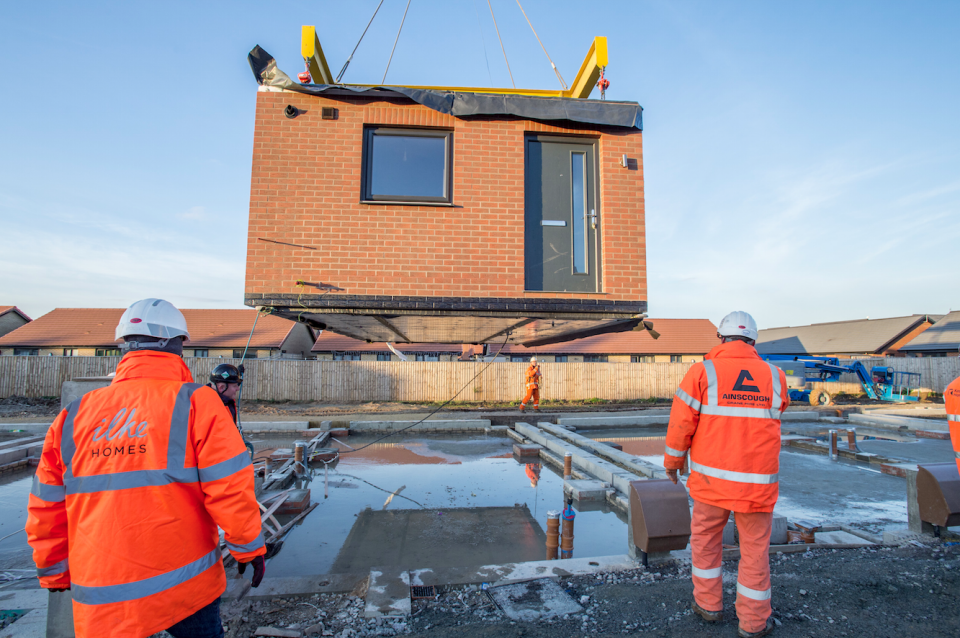
The real selling point is speed. Houses and apartments are built as a series of identical blocks or ‘modules,’ often with bathrooms and kitchens already fitted. Because walls and floors are precisely engineered and there are no real-world variables like bad weather, a home can be made in a couple of weeks. The modules are then transported to the site and craned in on top of each other to make a house, or stacked around a concrete core to create an apartment block. Projects vary, but using modular elements usually cuts construction time by at least half.

These are not piled-up, boxy apartments, but large, light, airy ­­­family homes. “They have a love of humanity, they understand how people want to live and what makes homes better and more attractive,” says Urban Splash founder Tom Bloxham. For example, Sekisui plants five indigenous trees around each of its homes – ‘three for birds and two for butterflies’. Its utopian vision of the world extends to humans, too. In Japan, homes are generally considered worthless and demolished after 30 years – so Sekisui buys them back and retrofits them before re-selling them to cash-strapped youngsters at a low cost.

I can’t see how you can create great architecture with modular

Peter Leiper, architect at CZWG

Urban Splash has already been building its own modular homes under its HoUSe brand. They are a modern incarnation of perennially popular Victorian and Georgian properties – high ceilings, three storeys, big windows – but wrapped up in a contemporary exterior. “If all you want is a house that looks like it’s built out of brick, build it out of brick,” says Bloxham. “For us, it’s more about how they perform.”

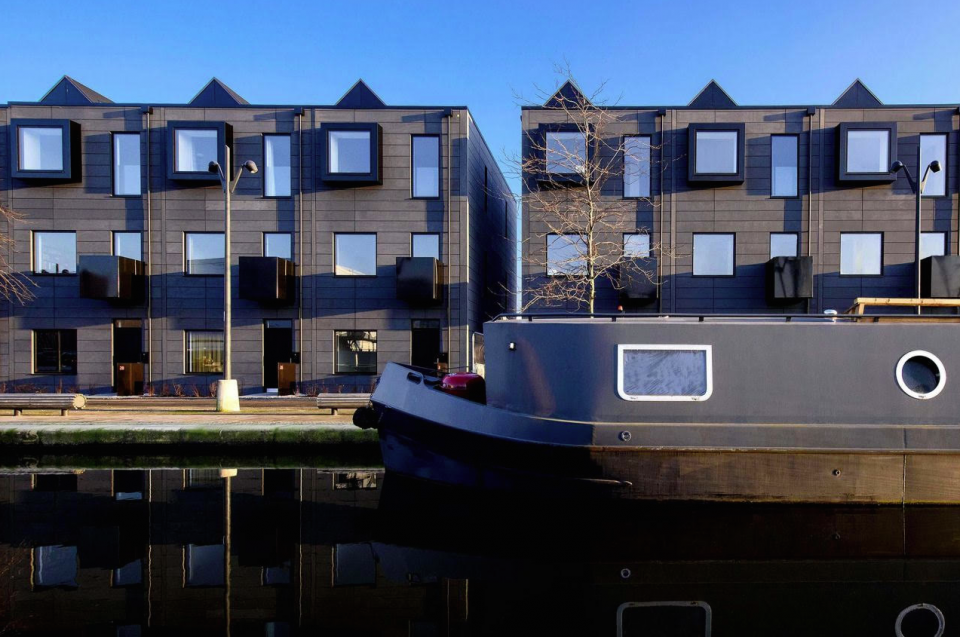
On the other end of the scale are the vast apartment blocks that have predominated in London so far. Tide Construction and Vision Modular Systems’ 101 George Street in Croydon, which is currently being built, would have been the world’s tallest modular tower at 135 metres and 44 storeys, but a block planned for Singapore will surpass it by five metres. “If you’re going to build a 44-storey building, it has to look great,” says Simon Bayliss, from project architect HTA Design.

Urban Splash’s modular ‘HoUSe’ homes

101 George Street will be covered in iridescent, dark green triangulated panels (pictured, top) that reflect the area’s art deco architecture, and there are certainly worse-looking towers in London. But some believe modular construction is at odds with attractive design. “I can’t see how you can create great architecture with modular,” says Peter Leiper, architect at CZWG. “You have to create [buildings] that are quite linear, where everything stacks up one above the other.”ADVERTISING

On completion, 101 George Street will be one of the growing number of build-to-rent blocks in London, owned by a corporate landlord with the 546 flats rented out to young professionals.

Some argue this is the only model – that modular only works with homes that aren’t for sale. This is because, no matter how quickly you build them, houses take time to sell – and housebuilders don’t want to end up with stock they can’t shift. “It’s being hailed as the great saviour of housing in Britain, but speed is the last thing housebuilders want,” says Leiper.

One area where this isn’t an issue is affordable housing. Demand is bottomless, and factory-built homes are hard-wearing and cheap to heat. Boklok, the modular company owned by Ikea, has already struck a deal with Worthing Council in West Sussex to build 162 flats, of which a third will be handed over to the council at cost for affordable housing. It also allows homes to be built in places where “conventional construction won’t work”, according to Dr Rehan Khodabuccus, operations director at Zedpods. His firm has installed homes on stilts above car parks, for example.

The sticking point is that it’s not cheaper than building a bricks-and-mortar home, because so much has been invested in developing the technology. “It will get cheaper, in the same way that cars and TVs eventually get cheaper,” says Bloxham.

An Ilke Homes house is craned in on a site in Hull

Modular homes are also eco-friendly, which is significant given that the construction industry accounts for 38 per cent of the world’s energy-related carbon emmissions. Bayliss thinks it’s “the only way” the UK can achieve its target to reach net zero emmissions by 2050, and this could be a selling point for eco-conscious home buyers. But the average person still doesn’t know what a modular home actually is. “It’s not penetrated the mainstream yet,” says Rory O’Hagan, architect at Assael. “But if you’re delivering really great homes, why should the technology be the first consideration for the purchaser?”

The idea that these are small, identikit, prefab homes will be a challenge to surmount, and the people building them know it. “We owe it to the British public to build only high-specification, quality, permanent housing that will create popular, aspirational dwellings,” says Khodabuccus. But given the need for new housing isn’t going away, the production lines look set to keep rolling.

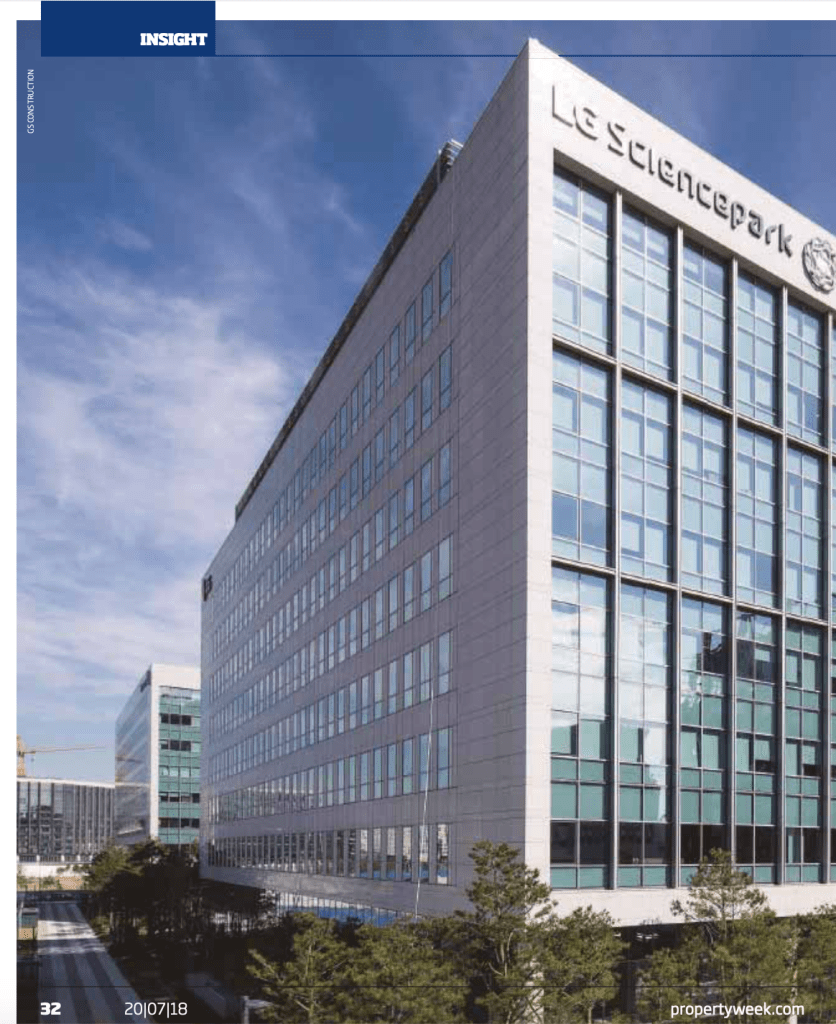
SEOUL SCIENCE: A VISIT TO THE WORLD’S LARGEST RESEARCH CAMPUS IN South Korea

Published in Property Week, July ’18

Photo by Sunyu Kim on Unsplash